Carbium: The Swiss-Engineered Edge for Solana Data Streaming
A practical 2026 guide to choosing JSON-RPC, WebSocket, or Yellowstone-compatible gRPC for Solana data. Learn when streaming changes the architecture, and when it does not.
The Race for the Edge
Solana applications do not all need the same data path. A wallet checking balances, a backend confirming transactions, a market-data listener, and a full-block processor can all be “using Solana RPC” while facing completely different timing, volume, and recovery requirements.
That distinction is getting sharper in 2026. Agave’s staged slot-time work is designed to move Solana from its familiar 400ms target through 350ms and 300ms steps on the way to 200ms, with each reduction gated so the network can pause if block-skip behaviour demands it. As the protocol pushes toward a 300ms cadence, the infrastructure question is no longer just whether an endpoint responds quickly. It is whether an application can receive, filter, recover, and act on data reliably inside a shorter operating window.
Standard JSON-RPC is still the right tool for direct reads and writes. Standard WebSocket is useful when an app needs targeted account, log, signature, or slot notifications. A Yellowstone-compatible streaming path matters when a system must continuously process transaction flow or complete block data.
Carbium is built as Swiss-engineered Solana infrastructure for teams that want a clear path from normal JSON-RPC to production streaming without treating every application as a high-frequency trading system. The question is not whether gRPC is “faster” in the abstract. The question is whether polling waste, event timing, or full-stream processing is a real architectural constraint for your product.
 Carbium
https://rpc.carbium.io
The Core Technology: gRPC and Geyser Explained
To understand Carbium's value proposition, one must first understand the limitations of the standard Solana infrastructure and the solution offered by the Geyser architecture.
The Bottleneck: JSON-RPC
Standard blockchain interaction relies on JSON-RPC, a pull-based model where clients poll the node for data. This introduces two critical latency sources:
- Polling Latency: You only get data when you ask for it. If a block arrives 10ms after your request finishes, you wait hundreds of milliseconds for your next polling cycle.
- Serialization Overhead: The node reads binary data, converts it to a text-based JSON format (base64 encoded), and sends it over HTTP. The client must then parse and decode it back to binary.
Standard WebSocket: targeted notifications
WebSocket pubsub is the middle ground. Use it when you need targeted updates such as account changes, program-owned accounts, logs, signatures, slots, or roots without running a full transaction-processing stream. It is often the correct choice for wallets, dApps, monitoring, and focused alerting.
The Solution: Geyser and gRPC
Geyser is a plugin interface that sits inside the Solana Validator. It hooks directly into the validator's memory, capturing account updates and transactions the instant they are processed.
gRPC (Google Remote Procedure Call) is the transport layer used to stream this data. Unlike the request-response model of HTTP/1.1, gRPC uses HTTP/2 to maintain a persistent, bidirectional connection. It uses Protocol Buffers (Protobuf), a binary format that is significantly lighter and faster to parse than JSON.
Carbium's implementation leverages this stack to convert the data flow from "Pull" (Polling) to "Push" (Streaming)
The Carbium Difference: Serving vs. Running
A common misconception in the Solana developer community is that running a Yellowstone gRPC plugin is sufficient to achieve low latency. As noted by the Carbium development team, "Anyone can run Yellowstone, but not everyone can serve the data it provides as a 'service'."
The Edge Architecture
Carbium distinguishes itself by optimizing the serving layer. While the open-source Yellowstone plugin provides the raw feed, distributing that feed to hundreds of concurrent clients without introducing latency requires a proprietary architecture.
- Custom Serving Layer: Unlike providers that might rely on default configurations or third-party SDKs, Carbium utilizes custom Rust implementations to manage the data distribution. This allows for tighter control over memory allocation and thread management.
- Latency Optimization: Internal benchmarks suggest Carbium is "winning the gRPC battle" against many standard providers and is within 8-9ms of the absolute fastest private edge providers in the world. This narrow margin places it firmly in the "Tier 1" category of infrastructure, suitable for high-frequency trading (HFT).
Swiss Infrastructure
Carbium is Swiss-engineered dedicated nodes. That matters as an operating and infrastructure choice, not as a universal latency promise. Network path, client location, commitment level, filters, workload, and recovery behaviour all affect observed results. Teams that care about execution timing should benchmark their actual read, stream, and transaction path from the environment where the service will run.
Use Cases: Calls that Shine on gRPC
While standard HTTP RPC methods are sufficient for fetching balances or historical data, the gRPC architecture unlocks specific high-frequency use cases that are physically impossible with standard JSON-RPC.
The Snipe: Detecting Token Launches
The Old Way (Polling): A bot repeatedly calls getProgramAccounts or getSignaturesForAddress on the Raydium program. This is slow, resource-intensive, and often rate-limited.
The gRPC Way (Streaming):
Clients use the subscribe method with a transaction filter. By filtering for specific instruction discriminators (e.g., the initialize2 instruction for Raydium or create for Pump.fun), the client receives the notification the millisecond the transaction is processed by the validator.
- Advantage: Zero polling delay. You receive the "New Pool Created" event in the same slot it happens, allowing you to land a buy transaction in the very next slot (or even the same slot if using Jito bundles).
The Arbitrage: Monitoring Liquidity Changes
The Old Way: Polling getAccountInfo for a specific AMM pool account every 500ms.
The gRPC Way:
Clients set up an account subscription for the specific AMM pool address (e.g., a SOL/USDC pool).
- Data Slicing: Carbium's gRPC allows the use of
accountsDataSlice. If you only care about the "Reserve" fields (which might be bytes 100-116 in the account layout), you can request only those 16 bytes. - Advantage: This drastically reduces bandwidth. Instead of receiving 1KB of account data for every price change, you receive a tiny packet containing just the reserve numbers, allowing your arbitrage engine to recalculate spreads faster than the competition.
The Scanner: Wallet and Program Tracking
The Old Way: Complex indexing infrastructure or sluggish getConfirmedBlock calls.
The gRPC Way:
A developer can subscribe to account updates with the owner filter set to a specific Program ID (e.g., observing all OpenBook interactions).
- Advantage: This turns Carbium into a real-time event listener. It is particularly powerful for "Copy Trading" bots that need to mirror the moves of a specific wallet address instantly.
Pricing and Availability
Carbium operates on a model that separates commodity access from premium edge access.
gRPC: Access from Business Plan and Above
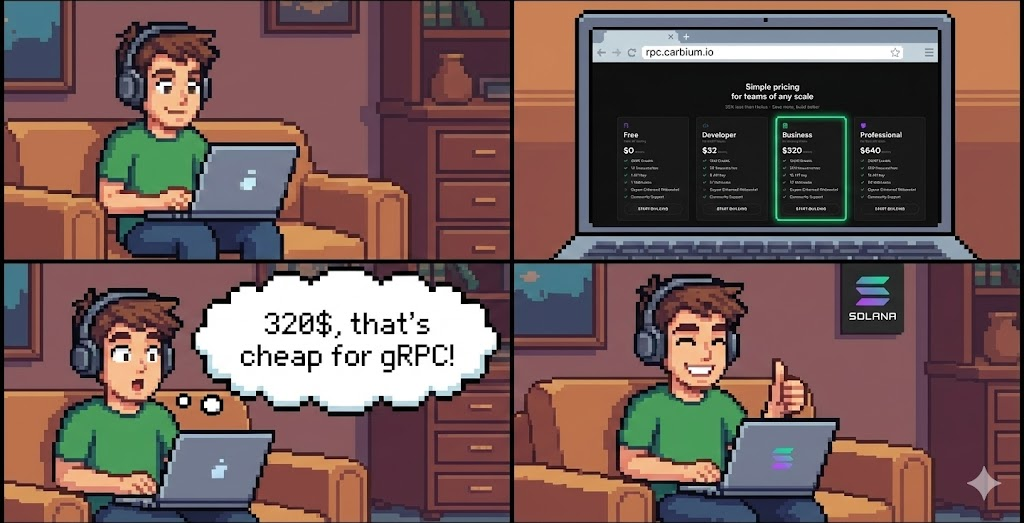
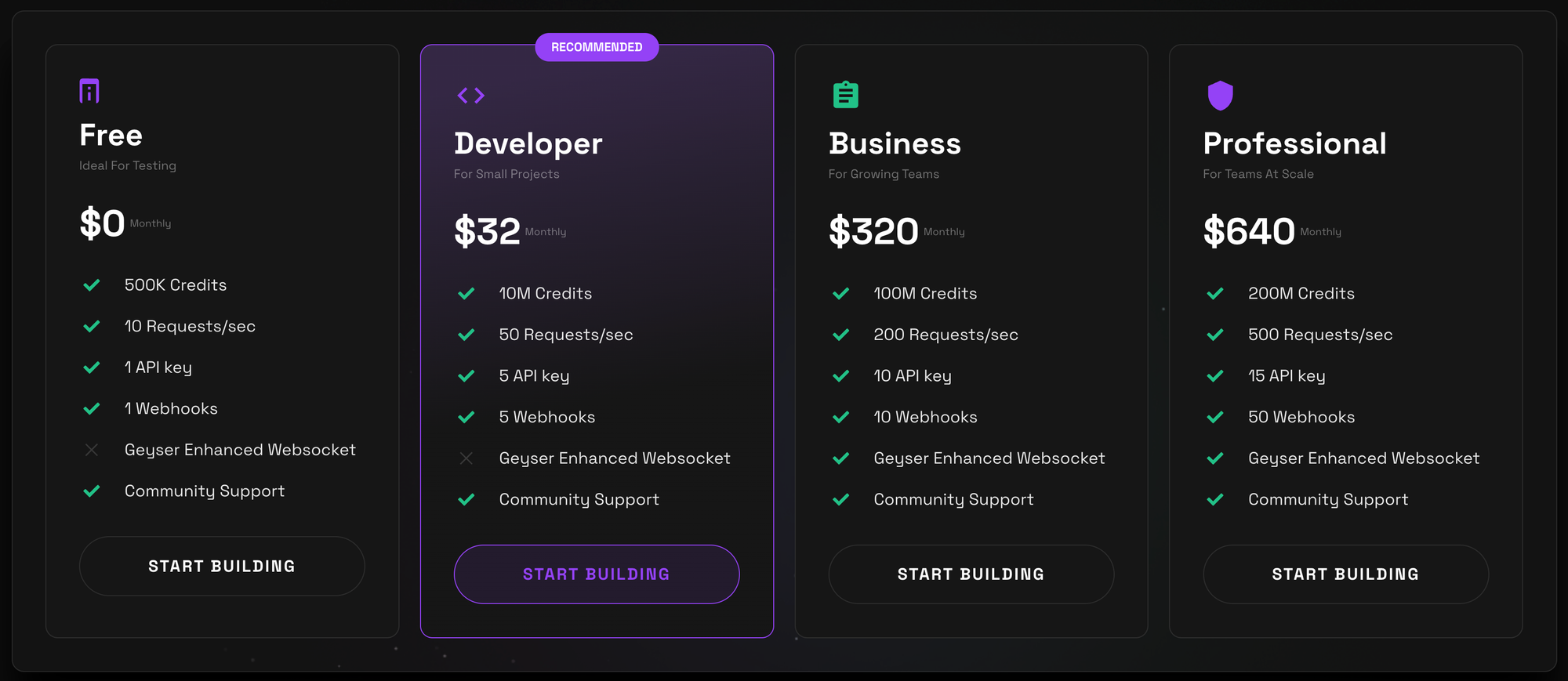
Access to the high-performance gRPC interface described in this report is currently restricted to the $320/month plan.
- Streaming raw data at the edge requires significant CPU and bandwidth resources per connection. Unlike standard RPC requests which are ephemeral, a gRPC connection is persistent and resource-intensive. Maintaining sub-10ms latency requires strict capacity planning, preventing the "noisy neighbor" issues found on free public tiers.
Standard Access
For developers who are not yet ready for the Business tier or doesn't have the need for streaming data, Carbium’s Free RPC and Developer RPC plans are providing top-of-the chart, sovereign bare-metal P50 and P95 speeds. This is convenient for testing but also sufficient for standard DeFi and other activities on chain. The hyper-optimized gRPC streams are prefect for production-scale trading.
The important commercial point is not a theoretical maximum-request calculation. It is that gRPC is part of the production-tier capacity decision, rather than a separate pay-per-GB streaming product. If real-time data is fundamental to the product, validate the actual stream path and capacity model before the system is designed around it.
View our Plans
Conclusion: Choose the Smallest Architecture That Solves the Real Problem
The mature 2026 decision is not “JSON-RPC versus gRPC” as a status symbol. It is matching the transport to the work.
Use JSON-RPC for normal reads, writes, and confirmation flows. Use WebSocket for targeted state and notification subscriptions. Use Carbium’s streaming path when continuous transaction flow, complete-block processing, event timing, or shared stream consumption is genuinely central to the product.
Carbium’s role is to give Solana teams a documented route from straightforward RPC to Yellowstone-compatible real-time streaming on the same infrastructure surface. Build the simplest system that meets the workload, then benchmark it under the conditions where it has to perform.
For current streaming plans and setup details, explore Solana gRPC streaming on Carbium.




 Carbium
How to Benchmark your RPC:
 Ukko Meta